HRC Fuses vs. Circuit Breakers: When to Use Which (And Why It's Not Always a Circuit Breaker)
HRC fuse, circuit breaker, protection coordination, LV switchgear, fault current, IEC 60269
Introduction The default answer on most modern electrical projects is a circuit breaker. They're resettable, they're familiar, and they look neat in a panel. But defaulting to circuit breakers without evaluating HRC fuses for every application is a habit that costs money, wastes panel space, and — in high fault-current environments — can compromise the safety of the installation. This guide gives engineers and procurement managers a clear, honest comparison. No brand advocacy. Just the engineering rationale for when each technology is the right choice.
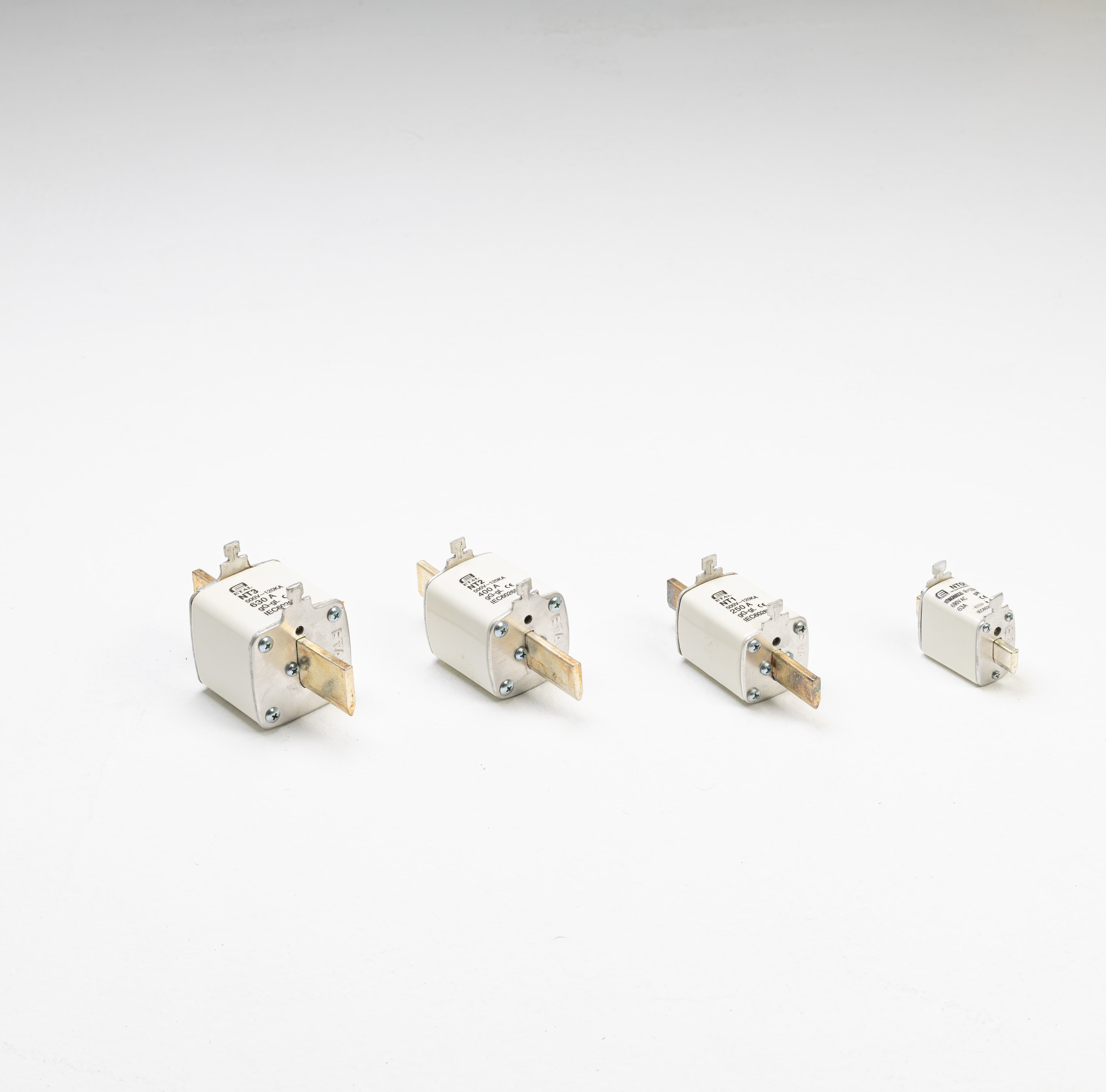
What Makes an HRC Fuse Different An HRC (High Rupturing Capacity) fuse is a sealed cartridge — typically ceramic or glass — filled with a quartz sand packing that surrounds a silver or copper fusible element. When fault current flows, the element melts, the arc is quenched in the sand, and the fault is cleared. The critical performance characteristic is breaking capacity: how much fault current the device can safely interrupt without itself becoming a hazard. A standard rewirable fuse: 2–4 kA breaking capacity. A typical MCCB (Moulded Case Circuit Breaker): 25–85 kA depending on frame and rating. A quality HRC fuse: 80–120 kA, with some industrial types exceeding 150 kA. That difference matters enormously at the incomer of a distribution board or at the LV terminals of a large transformer, where prospective fault levels regularly exceed 25–40 kA.
Head-to-Head Comparison ParameterHRC FuseCircuit Breaker (MCCB/MCB)Breaking capacity80–150 kA (class dependent)10–85 kA (frame dependent)Operating speedSub-cycle (< 5ms)1–3 cycles (20–60ms)Current limitingYes — reduces let-through energyLimited (some MCCBs only)Reset after faultNo — requires replacementYes — re-close and restoreMaintenance requirementNone until faultPeriodic inspection requiredPanel spaceVery compactLarger footprintInitial costLowHigherLong-term costReplacement cost per fault eventLower if faults are frequentRemote operationNot possiblePossible with motorized versionsSelectivity / discriminationRequires careful gradingEasier with modern trip units
When HRC Fuses Are the Right Choice High fault-current environments Wherever the prospective short circuit current (PSCC) is high — incomer positions, bus sections, transformer LV terminals — HRC fuses provide fault interruption capability and current-limiting behaviour that many standard circuit breakers cannot match at comparable cost. Current limiting means the fuse interrupts the fault before the current has reached its peak, dramatically reducing the mechanical and thermal stress on downstream equipment. This is not just a protection advantage — it has real implications for the mechanical integrity of busbars, switchgear frames, and cable terminations. Minimal maintenance installations HRC fuses are passive devices. There are no moving parts, no contact surfaces that wear, no trip mechanisms that drift out of calibration. An HRC fuse that has not operated is in exactly the same condition it was when installed. In locations where access is difficult or maintenance resources are limited — remote substations, rural distribution kiosks, utility distribution boxes — this reliability under storage is a significant operational advantage. Space-constrained panel designs HRC fuses and fuse bases are physically compact. A 400A HRC fuse assembly occupies a fraction of the volume of an equivalent MCCB. In tightly designed distribution boards, this can be the deciding factor. Cost-sensitive applications with infrequent faults For circuits where fault events are rare — transformer protection, incomer protection, motor feeder protection where the motor starter handles overloads — the lower unit cost of HRC fuses and the rarity of replacement makes them highly economical over the installation's lifecycle.
When Circuit Breakers Are the Right Choice Circuits with frequent overcurrent events If a circuit regularly experiences overloads — motor starting circuits, welding equipment, variable loads with high inrush — requiring a fuse replacement each time the protection operates becomes a maintenance burden. Circuit breakers can be reset immediately, restoring supply without replacement parts. Applications requiring remote operation or monitoring If the installation requires remote switching, load shedding, or integration with a SCADA or BMS system, a motorized or electronically tripped circuit breaker is the only option. HRC fuses cannot be remotely operated. Where precise overload discrimination is critical Modern MCCB and ACB trip units allow precise adjustment of overload, short-circuit, and earth fault thresholds. This makes it easier to achieve full protection coordination (selectivity) across a complex multi-level distribution system. For simple systems with few voltage levels, HRC fuse grading achieves good coordination. For complex industrial installations with many protection levels, adjustable electronic trip units give the designer more control.
A Common Misconception: "Circuit Breakers Are Always Safer" This is not accurate. Safety depends on the device being correctly rated and correctly applied — not on the device category. An HRC fuse correctly rated for the fault level of an installation is safer than an MCCB with an insufficient breaking capacity. The fuse will interrupt the fault. The MCCB may fail to interrupt it, or may interrupt it at the cost of significant damage to internal contacts — creating a device that appears intact but is no longer reliable. The question is never "fuse or breaker?" It is always: "what is the fault level, what is the load behaviour, and what does the application require?"
Protection Coordination with HRC Fuses Selectivity — ensuring that only the device closest to the fault operates, leaving the rest of the system live — requires careful grading between devices in series. For HRC fuse systems, selectivity is achieved through fuse grading ratios. As a general rule, a ratio of at least 1.6:1 between the upstream and downstream fuse ratings provides adequate selectivity for most LV distribution applications. Example: If the feeder fuse is 100A, the incomer fuse should be no less than 160A to ensure the feeder fuse clears a fault without blowing the incomer. For mixed systems (HRC fuse at the incomer, MCBs on final circuits), the coordination must be verified against the fuse and breaker time-current characteristics — not assumed. Manufacturer documentation should be consulted to confirm the discrimination range.
The IEC Standard HRC fuses for LV applications are covered under IEC 60269 (Low-voltage fuses). This standard defines:
gG / gL type: general purpose, full-range protection for cables and general circuits gM type: motor circuit protection (higher tolerance for starting inrush current) aM type: motor starting protection only (not full-range — must be combined with an overload relay) gR / gS type: semiconductor protection (ultra-fast, used with VFDs and power electronics)
Specifying the correct fuse type for the application is as important as specifying the correct current rating. All ETAL HRC fuse products comply with IEC 60269 and are available in standard DIN and BS configurations.
Quick Decision Guide Use this as a starting framework — not a substitute for proper protection coordination analysis: ConditionRecommended devicePSCC > 50 kA at the installation pointHRC fuseRemote operation requiredCircuit breakerInfrequent fault events, cost-sensitiveHRC fuseFrequent overload trips expectedCircuit breakerSpace is severely constrainedHRC fuseComplex multi-level discrimination requiredCircuit breaker with electronic trip unitRural / low-maintenance siteHRC fuseMotor feeder with DOL starteraM fuse + overload relay, or MCCB
Conclusion HRC fuses and circuit breakers are complementary technologies, not competing ones. The mature design approach uses both: HRC fuses where high breaking capacity, current limiting, and passive reliability are priorities; circuit breakers where resettability, remote operation, and fine-tuned discrimination are required. The mistake is applying one technology everywhere by default — and then wondering why the installation doesn't behave as expected when the first serious fault occurs.